
This year marks a defining moment in APAX LAB history: Nemo Pop, our very own researcher and Water Wizard, has just been crowned the World AeroPress Champion 2025.
From months of experimentation with Waved Technology to a recipe built on simplicity, precision, and intention, Nemo crafted a cup that stood out on the global stage.
We are honoured to share his journey in this Hall of Fame feature.
1. Winning the World AeroPress Championship is a completely different stage. How did this experience feel compared to winning the Australian title earlier this year?
Honestly, it felt surreal. Winning nationals already had me on a cloud, but stepping onto the WAC stage was something entirely different. I was surrounded by people who are all champions of their own countries, so competing alongside them felt crazy in the absolute best way, and also quite intimidating. When I won, I felt incredibly proud; now I’m feeling mostly grateful for everyone who supported me, pushed me, and believed in what I was doing.
I’m talking about APAX LAB of course, but also Fidelity Coffee in Katoomba, those guys have been with me since the beginning. I’m talking about Jibbi Little, who believed in me and helped me train. I’m talking about my frenchies at KAWA (now known as Tanat), where I was able to thrive in Paris, and also KB where my coffee journey really began. Seoul was not only ME winning, but all of those people winning alongside me. I’m eternally grateful.
2. Your approach and practice likely evolved a lot through months of research and experimentation. Was there any shift in your technique or mindset between Nationals and Worlds?
The preparation for nationals and for worlds was very different, but not because I changed how I brew the AeroPress, quite the opposite actually. For nationals, we had to come up with a recipe that fit exactly what we wanted to serve: a sweet, round, delicate but balanced cup. We had to come up with all the different parameters for the recipe.
For worlds, the strategy was basically the same: sweet, round, balanced. So during preparation, before knowing the competition coffee, I tried to prepare myself for all possible scenarios. I dialled each “type” of coffee, different origins, roast styles and more, and spent my time developing refined water profiles for each type of coffee, all while still using the exact same base recipe, same grind size for all, same method.
3. You’re deeply involved in APAX LAB’s R&D, especially with Waved Technology. How did your research influence your routine and recipe at Worlds?
At APAX, I’m currently researching the use and application of Waved Technology, and furthermore, how to incorporate it into our products. So of course, these days when we compete, we are using Waved. This also highly impacts the way we dial in because it immediately improves the body, the sweetness, and helps with dryness and bitterness, allowing us to focus on other properties of the cup. This is a crazy time-saver, which was extremely helpful when dialing for Worlds, as we only had 12 hours with the coffee before competing.
4. The AeroPress format is known for creativity and freedom. How did you balance innovation with consistency when building a recipe for a global stage?
In my opinion, the most important thing when creating a recipe for AeroPress (and also for everything in competition, if you ask me) is to keep things simple. You have to understand which parameters really matter, and keep the base simple to have room to adjust what has the biggest impact. For example, my base recipe is very simple: the exact same ratio I was already using last year, and we just add on top things like sifting or using a precisely engineered water with Waved prototypes.
5. How did water help you achieve your winning cup? What was your winning water + AeroPress recipe?

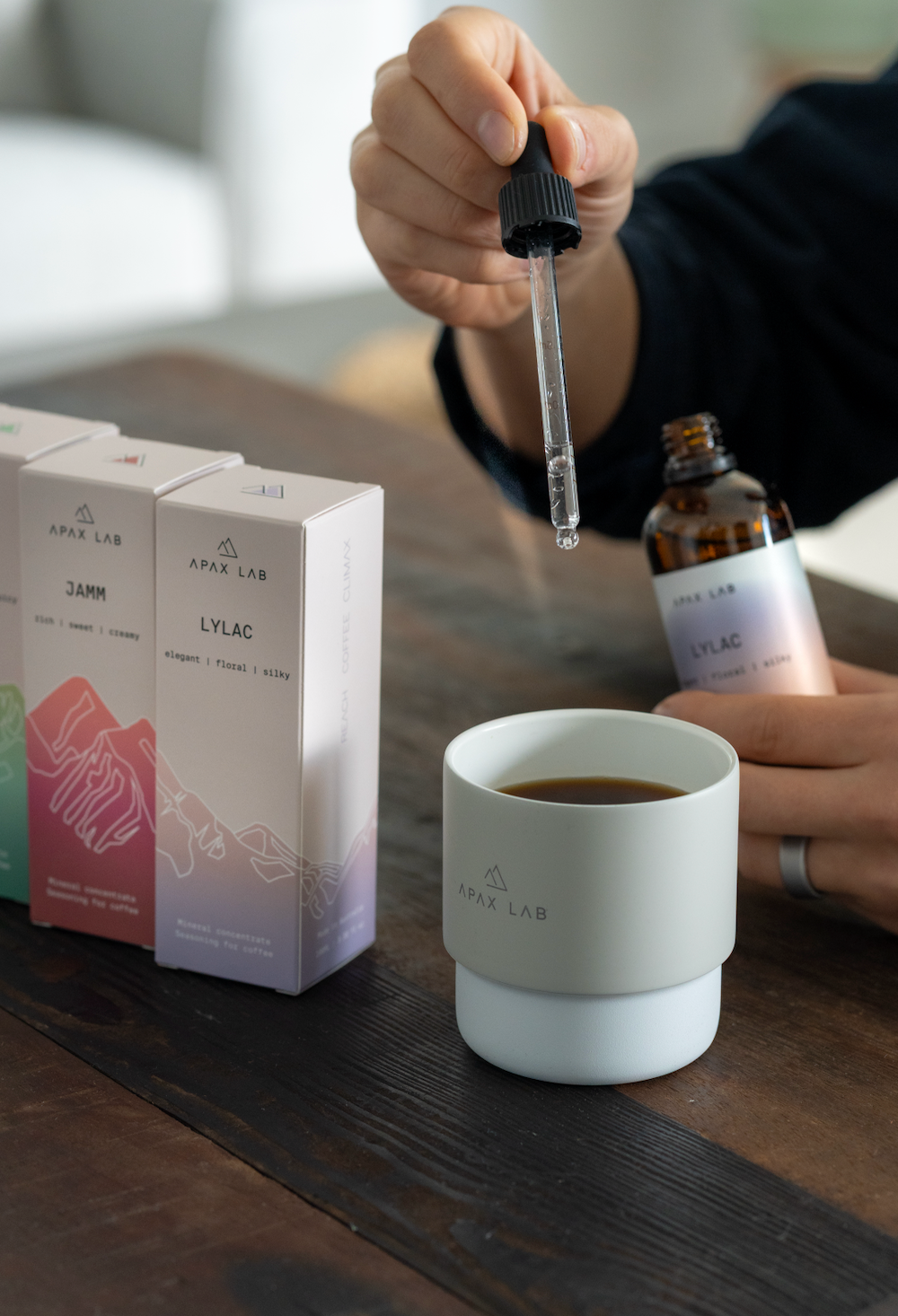
Water was an integral part of my recipe. It’s surely the most important aspect of all, as water is about 98% of a cup of coffee. With minerals, and also with the implementation of Waved, I can achieve this round, velvety mouthfeel. With the right balance of each of the APAX profiles, I can achieve balance in flavours, the characteristic sweetness we were after, and most importantly this very controlled acidity that made my cup stand out.
Winning water recipe: Using 1 L of water demineralised via RO
1.9 g JAMM | 1.4 g KONFLUX | 0.6 g LYLAC
(using the latest prototype version of each profile)
The final brewing water was around 120 ppm.
Competition coffee: Washed Sidra from Finca La Carolina in Ecuador, roasted by Stereoscope in Seoul, Korea.
6. Looking back at your journey this year, from testing in Australia, to training with Simon, to the Waved prototypes, what was your biggest breakthrough moment?
I’ve learned an insane amount of things since I arrived at APAX. My vision about coffee changed a million times, and I probably learned more in the last few months than in two years of working in specialty before that.
There was one moment that changed everything for us, when working with Simon on how to make Waved work with APAX. I had crafted a first prototype that we wanted to compare to the “typical” use of Waved in competition (how Carlos Escobar and Simon used the machine at the World Brewers Cup 2024, initially). We were interested in whether we could replicate the effects of the Waved machine but in a mineral concentrate bottle.
The first prototype wasn’t working — people were finding it even worse than the control. We organised a few tasting panels in Sydney to conclude my research in Waved, and we were surprised: I had served a new prototype, a new way to combine Waved and APAX, and while we weren’t convinced and almost decided to stop working, it worked.
The panels concluded that the prototype was good — very good. It was sweeter and rounder than the control, but also sweeter than the “competition” use of Waved. Out of nowhere, we had found something that could end up being revolutionary.
This prototype changed everything for us because this is what we used to make the water that helped us win the Australian Brewers Cup and the World AeroPress Championship this year — without even needing the (somewhat bulky) Waved machine with us. That’s what is called a breakthrough.
7. What did you learn about yourself as a brewer through this championship run? Something you didn’t know before competing at this level.
First, the importance of organisation. Even though I was already quite organised, I learned how incredibly helpful it was having everything sorted in advance, and having plans for any problem that could occur during competition days. It definitely helped at the AeroPress — the whole routine was so well prepared and so smooth that when I was on stage I felt completely relaxed and sure about every move. I had everything ready for the whole comp day as soon as I arrived at the venue: beans sorted and dosed, water prepped, and more. I literally had all I needed ready in a box and never needed to stress about missing something.
8. AeroPress has a reputation for community, creativity, and fun. What moment from Worlds captures that spirit for you?
For me, it was all the moments outside the actual rounds: meeting everyone in Seoul beforehand, coffee-hopping together, the APAX event, all of it. Between rounds we were just hanging out, bonding, sharing random brewing thoughts and having nerdy talks with other competitors. That mix of community, curiosity, and genuine fun is exactly why the AeroPress scene is so special, and Worlds captured that perfectly.
9. Your win will inspire a new generation of brewers. What advice would you give to someone dreaming of stepping onto the AeroPress stage for the first time?
Simplicity of recipe and having fun.
If I have to give just one piece of advice — one that was given to me and I’m grateful for, because it’s probably why I won — it’s to not change anything last minute. With stress, you will see problems where there are none, and you may want to change every single parameter “just in case it could make it better.” Stick to the plan, stick to the recipe.
Before the competition, get one bag of dark roast, one of light roast, one African, one South American. Try to cover as many bases as you can, so when you get the comp coffee, you already know what to do.
10. And finally, what comes next? What are you excited to explore moving forward?
I’m about to go back to Europe for a while. I’m very excited to keep working with APAX from over there, organising events and continuing to teach people about minerals, because for me it’s the best tool to dial coffee. I’m also looking forward to refining the work we achieved this year with Waved. We have a prototype that works unbelievably well, and I’m excited to create a version we can share with the world.
Finally, I’m always looking for the next challenge. I want to keep competing, but AeroPress is done. That means only one thing… Brewers Cup, I’m coming for you!
Conclusion
Nemo Pop’s journey from APAX LAB researcher to World AeroPress Champion is a testament to curiosity, precision, and the power of simple ideas executed brilliantly. His mastery of water, his relentless experimentation with Waved prototypes, and his disciplined approach to brewing allowed him to craft one of the most memorable cups of the season.
We are honoured to celebrate this milestone with him, and we cannot wait to see what he brings to the Brewers Cup stage next.
Congratulations to Nemo Pop, 2025 World AeroPress Champion!