
For this special Hall of Fame feature, we are turning the spotlight inward.
Simon Gautherin, co-founder of APAX LAB, represented Australia at the World Brewers Cup in Brussels just two weeks ago and placed 2nd in the world.
It was a deeply personal competition season, built around years of thinking, teaching, testing and refining one central idea: clarity.
For Simon, this routine was not only about serving an exceptional cup of coffee. It was about sharing a brewing philosophy he has been developing for years, one focused on making coffee easier to understand, easier to enjoy and easier to connect with.
We sat down with Simon to discuss the World Brewers Cup, his approach to clarity, the coffees behind his routine and the role APAX LAB played in shaping the final cup.
Tell us more about the World Brewers Cup. What made this competition so meaningful to you this year, and what did representing Australia on the world stage mean to you?
This competition was very meaningful to me this year because I had the chance to represent Australia on the world stage, exactly 10 years after I first arrived in this country.
It was also a competition I had been preparing for over a long period of time, with a concept I had been developing for years around clarity and around serving cups that are easier to drink and easier to connect with.
That is what made this year so meaningful to me. It felt like the right moment to share an idea that has shaped so much of my work in coffee.

You built your presentation around clarity. What did that word mean to you in the context of this routine, and how did it shape your decisions?
Clarity is something I had wanted to talk about for a long time.
After travelling around the world for several years, I realised that people often connect most easily with certain types of coffees: cups with high clarity, distinct flavours, lower extraction, weaker strength and higher levels of minerals.
Those coffees are often easier to read. Easier to understand. Easier to enjoy.
So I wanted to share this concept with the world and help people think about how we can brew coffee with better clarity.
For this routine, clarity shaped everything: the coffees we sourced, the flavour spectrum we focused on, the way we brewed, the way we used water and the way we communicated the experience.
As the founder of APAX LAB, water is obviously central to your work. How did your understanding of water influence your approach to the competition?
Water was obviously a central part of my work.
It is something I have pioneered, researched and spoken about for many years. Water is one of the foundations of every single cup we brew, and it is paramount to the success of anyone competing at a high level.
But for this world championship, I did not want to talk exclusively about water.
This time, I wanted to focus more on brewing and clarity. Water became the final element that allowed me to bring into focus exactly what I wanted to serve.
It was not the whole story. It was the tool that helped make the story clear.
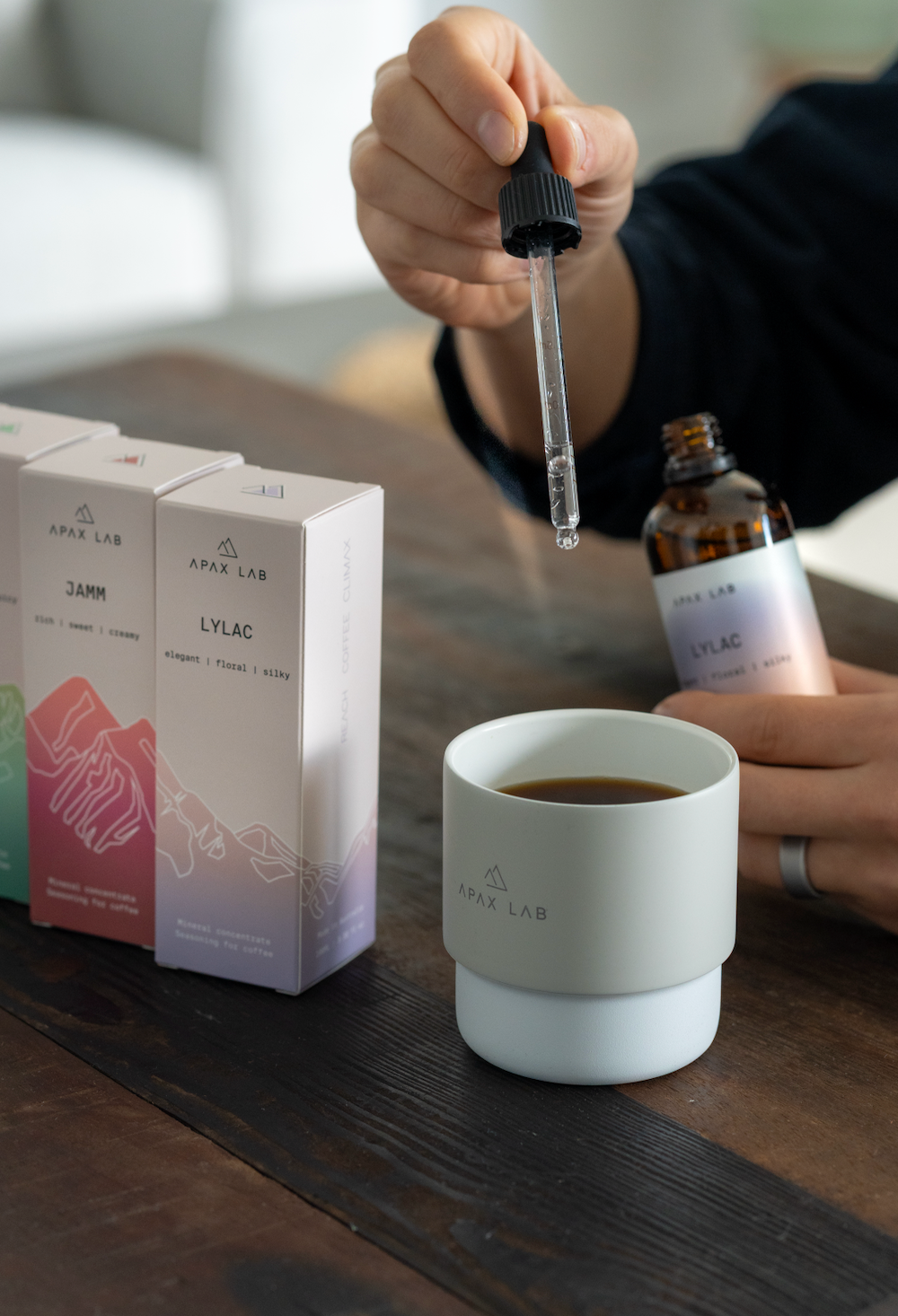
How did you use APAX LAB mineral concentrates to refine the expression of your coffees and bring your sensory vision to life?
They helped me easily shape the exact expression of the coffees I had in mind. Closer to the competition as coffee changed a little, it was extremely easy for me to bring it back on track with minor changes to the water to adjust acidity, sweetness and mouthfeel.
What was your final water recipe with APAX LAB, and how did it influence the cup’s clarity, sweetness, acidity, texture and balance?
My final water recipe was a new profile we developed specifically for this competition.
It featured some of the texture and structure of KONFLUX, some of the florality and elegance of LYLAC, and a lot of the sweetness you can find in JAMM.
It was also built using the Waved technology, similar to what we had done in previous competition projects.
The goal was not to create the strongest or most intense water. The goal was to create a profile that helped the coffees express the cup I had in mind.
It brought sweetness, structure and mouthfeel, while keeping the cup clear and easy to read.
For this presentation, that balance was everything.
What was the biggest lesson you took away from placing 2nd at the World Brewers Cup?
The biggest lesson was to trust my instinct.
During preparation, we made more mistakes by not following our gut and listening too much to what other people thought we should do. That almost cost us a place in the finals.
At this level, feedback is important, and you need people around you who can challenge you. But at the end of the day, you also need to remember that you are the one building the routine. You are the one who knows the concept, the coffees, and the cup you want to serve.
I learned that trusting your instinct is not about ignoring advice. It is about knowing when to come back to your own vision.
What is your motto, or a favourite quote that guided you through this competition season?
A quote that guided me a lot this season is from Einstein:
“If you can't explain it simply, you don't understand it well enough.”
This resonates deeply with me, especially when it comes to clarity.
I think when we cannot explain something in simple terms, it often means we do not fully understand what we are talking about yet.
That became a big part of the routine. I did not want to make coffee feel more complicated. I wanted to explain complex ideas in a way that felt easy to understand, easy to follow, and easy to connect with.
For brewers who want to start taking water more seriously, what advice would you give them?
Start by isolating variables. If you want to understand water, do not change everything at once. Change one thing, taste, assess the impact, and then move from there.
It can even be useful to explore individual minerals first, or to test different mineral concentrates one at a time, so you understand what each one does to the cup.
Try to dial in your coffee as much as possible by only changing the water.
When you understand how different minerals, concentrates, or mineral mixes affect attributes like acidity, sweetness, texture, florals and balance, you can start making much more methodical decisions.
That is how water becomes a real brewing tool, not just something in the background.
Final Thoughts
Simon’s 2026 World Brewers Cup journey was built around one clear idea: making coffee easier to connect with.
Through careful coffee selection, intentional brewing and a custom APAX LAB water profile, his routine explored how clarity can help people experience flavour in a more immediate and memorable way.
Placing 2nd in the world is an incredible achievement, but this routine was also a reflection of something much bigger: years of research, teaching, competition, product development and a belief that coffee does not need to be more complicated to be more meaningful. Congratulations to Simon Gautherin, 2nd place at the World Brewers Cup 2026!