
If you’ve been using APAX LAB for a while, you’ve probably asked yourself: Should I add minerals before brewing? Or should I season the cup after?
The short answer: both work. The better answer: it depends on who you are, how you brew, and how much control you want.
Let’s break it down clearly.
What Actually Changes (And What Doesn’t)
For years, many people believed that minerals were primarily extraction tools, and that adding calcium or magnesium would significantly change how compounds are extracted from coffee.
Today, we understand this more precisely. Minerals do not fundamentally change extraction mechanics in the way people once thought. What they influence is how we perceive flavour: sweetness, structure, brightness, balance, mouthfeel.
Whether minerals are added before brewing or after, the final sensory outcome can be extremely similar.
For most people, in most situations, the difference in taste is minimal. What changes is not extraction efficiency. What changes is control, flexibility, and integration.
Think of it like seasoning food. Salting eggs before cooking versus after cooking can create subtle differences. Some chefs can tell. Most people can’t. But the intention and workflow are different.
The same applies here.
Pre-Brew Mineralisation

Preparation, Integration & Predictability
Pre-brew means building your water in advance.
You start with demineralised water or soft water (generally defined as water below 40 ppm total mineral content), and you add your chosen APAX profiles to create your full brewing water.
The minerals are fully dissolved and evenly distributed before brewing begins.
Why people choose pre-brew:
- Maximum repeatability
- Time efficiency during service or in the morning at home
- Highly integrated, uniform cup experience
- Slightly more cohesive flavour expression
- Competition-ready precision
Because minerals are fully integrated into the water, the cup can feel marginally more uniform and less perceptibly “mineral-driven.” The experience can be slightly more seamless from first sip to finish.
Pre-brew is generally recommended for people who:
- Know their coffees extremely well
- Can predict flavour outcomes
- Understand their brewing method deeply
- Are highly familiar with how each mineral profile behaves
It is a precision-driven approach.
That’s why competitors often prefer pre-brew. Once they’ve dialled the perfect combination, they want absolute accuracy, replicability, and no surprises on stage.
Pre-brew is about mastery and predictability.
Post-Brew Mineralisation

Flexibility, Learning & Creative Control
Post-brew means brewing first, then adjusting.
You taste the coffee as it is. Then you decide what direction to give it. More sweetness? More structure? More balance? Less brightness?
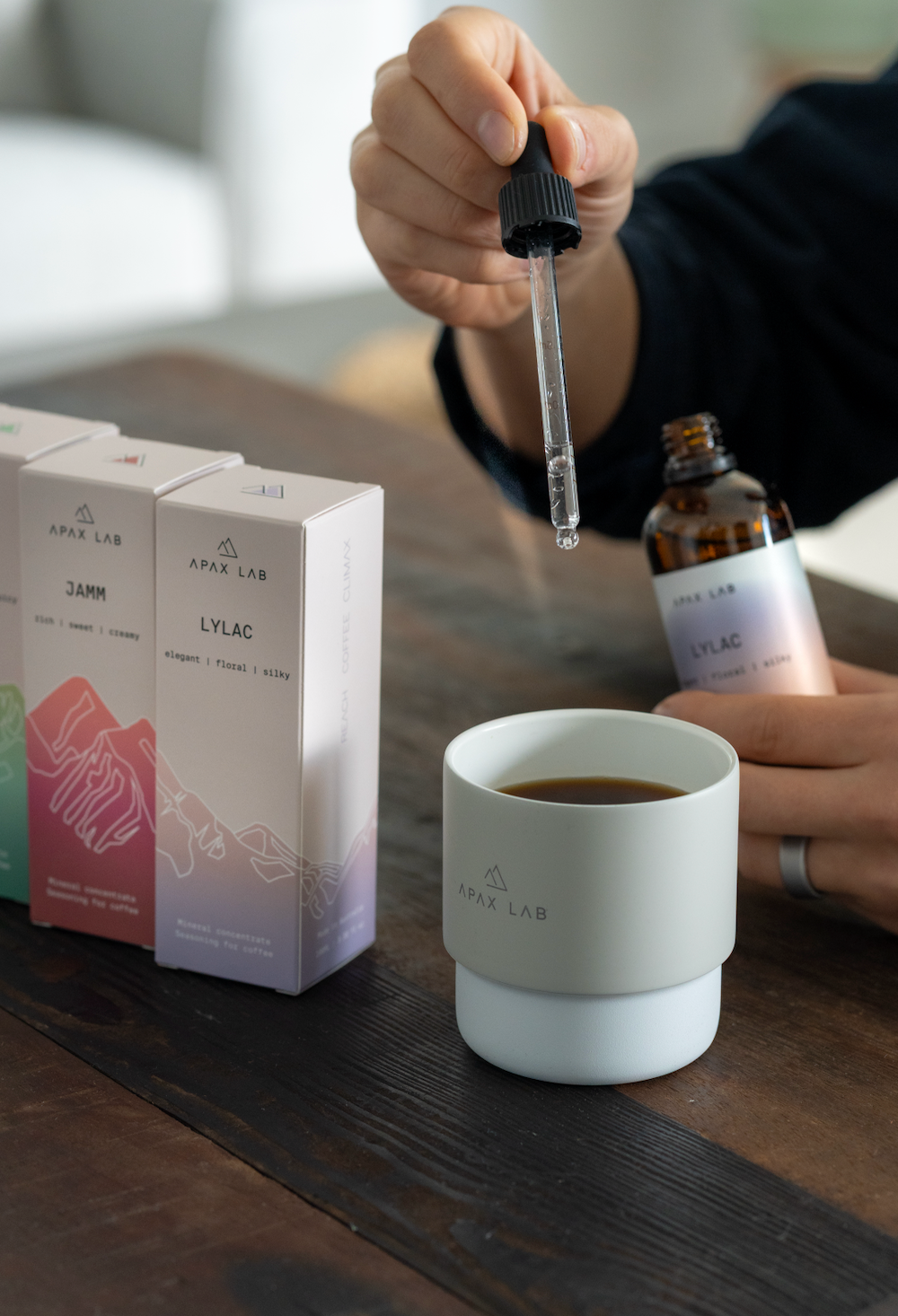
You add minerals directly into the cup.
Why post-brew works beautifully:
- Total flexibility
- Ideal for unfamiliar coffees
- Educational and intuitive
- Immediate before/after comparison
- Visually powerful (great for cafés & workshops)
Post-brew is particularly effective for people who:
- Are still discovering how minerals behave
- Are working with new coffees regularly
- Want to adjust dynamically
- Prefer reacting rather than predicting
It turns every brew into a controlled experiment.
And importantly: most people cannot taste whether minerals were added before or after brewing. The perceived difference is often negligible.
Post-brew is about exploration and intention.
The Café Model: Think Like a Kitchen
If we look at professional cafés, their workflow mirrors a professional kitchen.
In a restaurant:
- Seasoning happens during cooking.
- But before the dish leaves the pass, the head chef tastes it.
- A final touch is added like a squeeze of lime, a pinch of salt, cracked pepper.
That final layer is quality control.
Cafés often operate the same way:
- Base water is prepared in advance (pre-brew) for efficiency.
- Then a final seasoning adjustment can happen in the cup (post-brew).
This hybrid model provides:
- Workflow efficiency
- Consistency during service
- Flexibility per coffee
- A final quality control layer before serving
It’s professional, intentional, and precise.
Three Real-World Use Cases
1) Home Brewers → Post-Brew
At home, you’re often exploring new coffees. You don’t necessarily know how each origin, roast or process will behave.
Post-brew lets you:
- Taste first
- Adjust second
- Learn through direct comparison
It’s the most intuitive way to build understanding.
2) Cafés → Hybrid Model
Professional cafés typically combine both:
- Pre-brew for workflow and consistency
- Post-brew for refinement and final quality control
It’s structured but adaptable.
3) Competitors → Pre-Brew
Competition demands predictability and precision.
Competitors:
- Build water in advance
- Lock in their mineral recipe
- Remove variability
Pre-brew ensures uniformity across multiple rounds.
So Which One Is Better?
Neither. Pre-brew is about mastery and repeatability. Post-brew is about flexibility and exploration.
One favours prediction. The other favours reaction.Both lead to exceptional coffee when used intentionally. And at APAX LAB, we design our profiles to support both.
Because whether you’re experimenting at home, running a café, or stepping onto the world stage, control over perception is what ultimately matters!