
Akira entered the 2026 US AeroPress Championship looking for a way into coffee competition.
Two months later, he left as the national champion.
His AeroPress journey had started casually in 2024, when he received an AeroPress XL as a gift. A year later, encouragement from his mentor and friend Pack Katisomskul convinced him to take competition seriously.
Akira approached his preparation systematically: dial in the recipe, understand what he liked and disliked in the cup, then experiment with the water until it supported the flavour profile he had in mind.
That experimentation continued right up to competition day, when he finalised his APAX LAB water recipe just two hours before the championship began.
We spoke with Akira about his first competition, his winning recipe, and what he is taking with him to the World AeroPress Championship.
1. Tell us about your journey with the AeroPress. How long have you been practising, and what made you decide to compete in the US AeroPress Championship this year?
I first got into AeroPress around mid-2024.
I received the AeroPress XL as a gift and had no idea how to use it, so I searched online and came across so many recipes by amazing brewers — some of them were even competitors this year!
At the time, I didn’t have the motivation to continue with the AeroPress.
However, in 2025, I upgraded a lot of my gear for pour-overs — grinder, kettle, scale — and bought the original AeroPress. I started toying with it here and there.
When I heard about the AeroPress Championship this year, my mentor and friend Pack Katisomskul encouraged me to apply.
I’d been itching to get into the competition scene and felt that AeroPress was the perfect entry point. I started seriously practising for the competition roughly two months before the date.

2. What was your approach going into the competition? Was there a particular flavour profile or cup experience you were trying to achieve?
My approach to competition revolved around a to-do list:
- Find and dial in a recipe.
- Identify what was desirable and undesirable in the brewed cup.
- Experiment with and lock in the water.
I wanted a cup that was bold, balanced, and beautiful.
Something that maintained juiciness throughout, with desirable brightness and sweetness, while still maintaining acidity, strength and body.
3. What coffee did you work with at the championship, and what did you learn about it while developing your recipe?
Before we received the mystery coffee, I was dialling in my recipe using both a natural-process coffee and a washed coffee from Thailand by Newbery St.
The mystery coffee, provided by Atomic Coffee Roasters, was a washed Ethiopia Ayla Bombe.
I found the coffee to have beautiful notes of orange peel, mango, and a juiciness I expected from Ethiopian varieties.

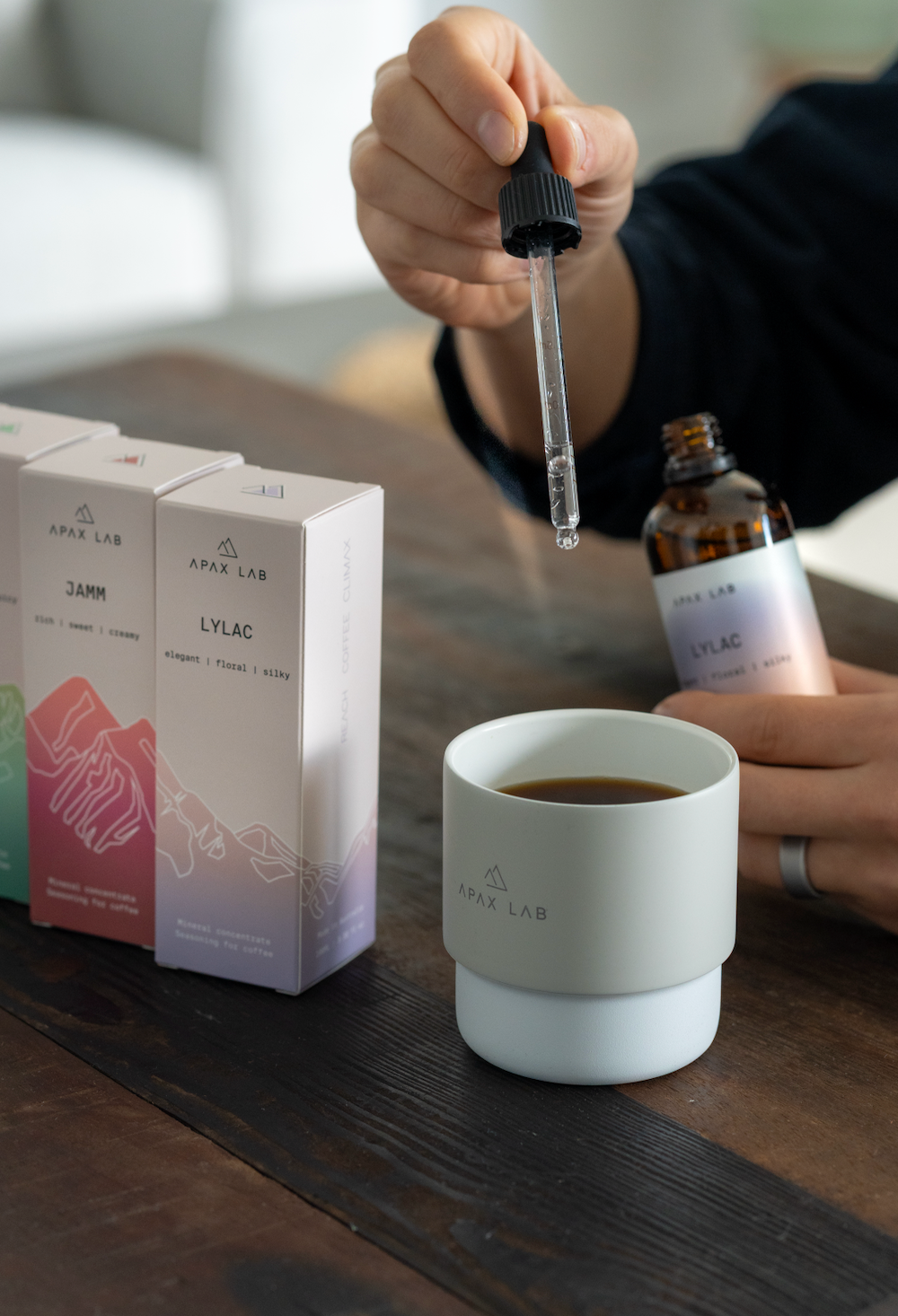
4. How did APAX LAB help you shape the final cup? Were there specific qualities, such as sweetness, acidity, texture, or clarity, that you were trying to bring forward?
APAX minerals really helped bring my desired cup together.
At the time, I was fighting a cold, so my senses of taste and smell weren’t working properly. Because I was already familiar with the flavour of the coffee, I relied heavily on mouthfeel while refining the final cup.
My goal was to emphasise the acidity and sweetness while supporting the texture I wanted in the cup. TONIK and KONFLUX gave me a useful direction for that.
5. What was your winning APAX LAB water recipe?
Per 250 ml of water, I used:
6. AeroPress competitions involve a lot of experimentation and quick decision-making. Was there anything you changed or discovered close to competition day that ended up making a difference?
I found that my cup was best served after cooling.
In my routine, I dedicated 30 seconds to swirling the coffee in my carafe to increase air exposure and bring the serving temperature down.
I also locked in the final water recipe two hours before the competition started, which thankfully turned out alright!
7. Now that you’ll be representing the US at the World AeroPress Championship, what are you most excited about, and how are you approaching the next stage?
I’m really excited to be surrounded by other national champions and to see them in action!
Since we won’t receive the competition coffee until the day before, I plan on practising several recipes and learning how different variables affect flavour and texture across different coffees.

8. For someone looking to compete in AeroPress for the first time, what advice would you give them?
Find a recipe that you enjoy. I think using previous winning recipes is a valuable resource, and that also helped me.
Start messing with the variables and see what changes. Keep a notebook and mark down those changes.
And last, but not least, trust yourself!
If competition is accessible to you, apply and see how it goes. You might just end up winning…

Final Thoughts
Akira’s first coffee competition began with other people’s recipes.
That was how he first learned the AeroPress, and it remained part of his approach to competition: find a useful starting point, change something, observe the result and keep learning.
By competition day, that process had become his own. Even with a cold limiting his usual senses, Akira adapted, refined his preferred serving temperature and continued adjusting his water until just two hours before the event began.
That final decision wasn’t the absence of preparation. It was the result of it.
Now, as the 2026 US AeroPress Champion, he takes the same approach towards Worlds: learn from what already exists, experiment carefully, understand what changes, and eventually trust yourself enough to make the call.
Congratulations, Akira! For someone who entered looking for his first step into coffee competition, that first step went rather well.
Or, as he puts it:
“You might just end up winning…”