
Cover photo credit: @motorscoffee (Instagram)
Thomas Philips does not brew with an AeroPress every day.
He first started using one around four years ago while training for the compulsory round of Brewers Cup. These days, it is mostly his travel brewer: practical, easy to pack, and reliable enough to come along on holiday.
But his approach to the 2026 French AeroPress Championship was anything but casual.
Although Thomas usually gravitates towards more floral coffees, he pursued something different on stage: immediate sweetness, clean fruit expression, satisfying mouthfeel and enough personality to stand out.
Working with a naturally processed Ethiopian coffee roasted by Parcel, he focused on amplifying its red-fruit character without allowing the fermented notes to dominate. Water, brewing ratio and temperature all became part of that refinement.
The result was a national title and a cup built around a simple philosophy Thomas continues to carry with him: make something memorable, and enjoy the process of getting there.
1. Tell us about your journey with the AeroPress. How long have you been brewing with it, and what made you decide to compete in the French AeroPress Championship this year?
I don’t actually brew with an AeroPress every day!
I first started using it about four years ago while training for the compulsory round of Brewers Cup. Over time, I really grew to enjoy it.
These days, it’s mostly my travel brewer: it’s practical, easy to pack, and perfect for making good coffee on holiday.
I entered the French AeroPress Championship partly to keep sharpening those compulsory brewing skills, but also because it’s such a fun competition. I love that you can take the coffee seriously without taking yourself too seriously.
2. What was your approach going into the competition? Was there a particular flavour profile or cup experience you wanted to achieve?
I wanted a cup that was really sweet and clean at the same time. That’s actually a little different from what I usually gravitate towards, as I tend to prefer more floral profiles.
For this competition, I wanted that immediate sweetness, but with enough clarity for the fruit to really shine through. Something generous and expressive, without becoming heavy.
3. What coffee did you work with at the championship, and what did you learn about it while developing your recipe?
We worked with a naturally processed Ethiopian coffee, really nicely roasted by Parcel. Big thanks to them!
The coffee already had a lovely red-fruit character, so I wanted to amplify what was naturally there rather than try to turn it into something else.
The biggest lesson was finding that balance: bringing out more fruit and sweetness without pushing the fermented notes too far.

4. How did APAX LAB help you shape the final cup? Were there specific qualities, such as sweetness, acidity, texture, or clarity, that you wanted to bring forward?
I was aiming for the kind of cup I felt would connect with the judges: plenty of sweetness, a satisfying mouthfeel, and no bitterness.
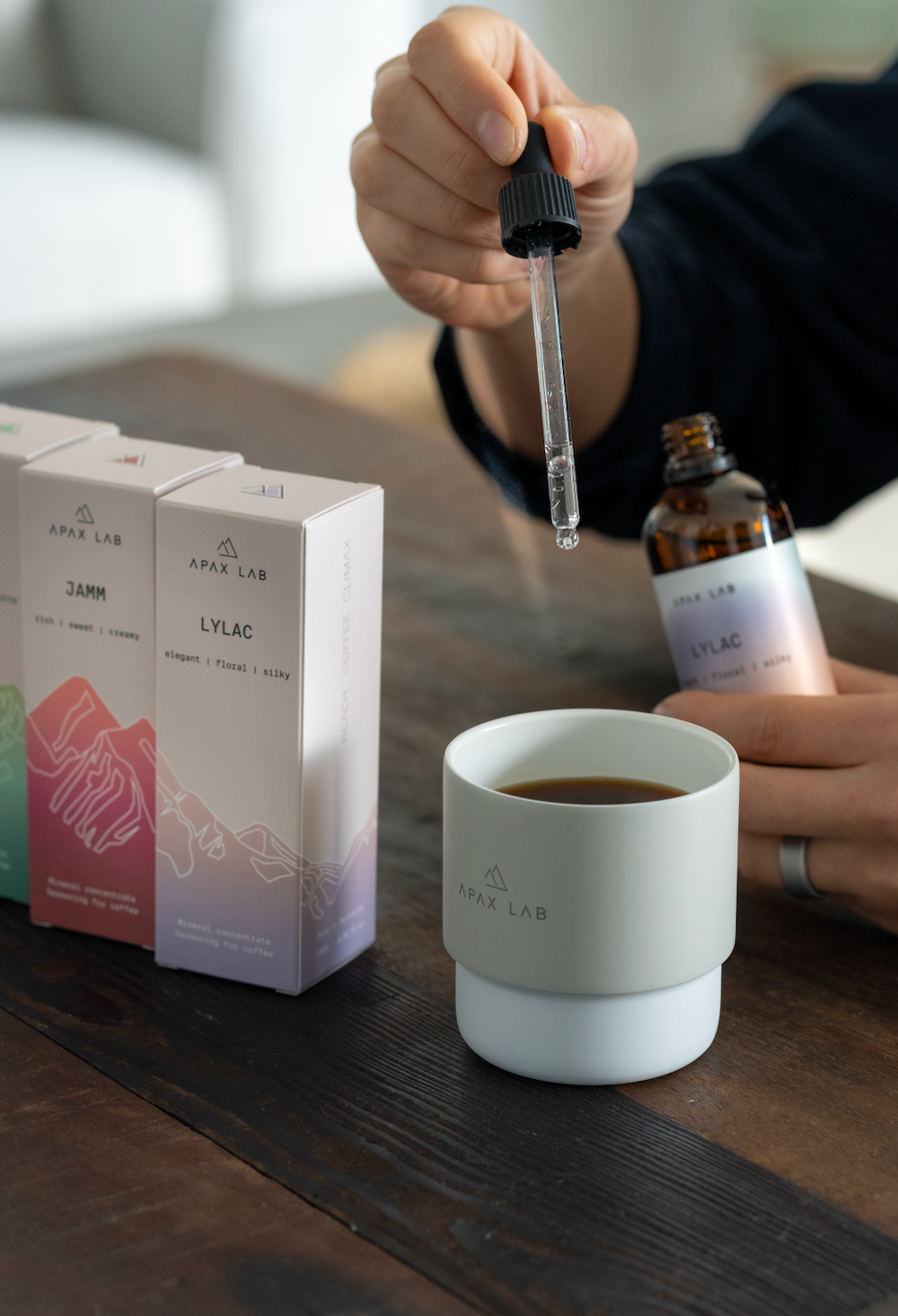
That immediately made me think of KONFLUX and JAMM, with JAMM ending up in my final recipe.
For me, APAX LAB was a way to fine-tune the cup, especially the sweetness and texture, while keeping the coffee’s fruit character at the centre.
5. What was your winning water recipe, and how did you arrive at that combination?
I always start with very low-mineral water.
My final water recipe was:
- 1 litre of Volcania, at around 50 ppm before adding minerals
- 1 ml of JAMM
- 2 drops of magnesium chloride and sodium bicarbonate mix
I started by adding JAMM to build sweetness and mouthfeel. There was still a slightly fermented edge that I couldn’t quite dial out, even after playing with the brewing ratio and temperature.
Adding two drops of AKVO Pink to that same litre helped soften the intensity while keeping the fruit intact. That gave me the balance I was looking for.
6. AeroPress competitions involve a lot of experimentation and quick decision-making. Was there anything you changed or discovered during preparation or close to competition day that made a real difference?
I came to the competition with one of my baristas and my wife. They took care of sorting the beans, which gave me time to squeeze in two test brews before going on stage. Definitely a team effort!
It was really cold that day, so I increased my brewing temperature by 2°C to get back to the cup I’d been tasting during practice.
A small adjustment, but it made a real difference. Having those two extra brews to check everything was really valuable.

Photo credit: @mahkeo (Instagram)
7. Now that you’ll be representing France at the World AeroPress Championship, what are you most excited about, and how are you approaching the next stage?
I’m so excited to go to Mexico. I love the country, and I genuinely love competing.
I’m a little addicted to that rush of adrenaline you get every time you step on stage!
Going up against more than 70 competitors is a huge challenge, and that’s exactly what makes it exciting for me. I’m heading into the next stage with that same energy: excited to push myself and really enjoy the experience.
8. For someone looking to compete in AeroPress for the first time, what advice would you give them?
AeroPress is such an accessible way to get into coffee competitions. You don’t need a huge budget to give it a go, and that’s something I really like about it.
My biggest piece of advice would be: don’t just chase your idea of the “best” cup.
Make a cup that stands out. Something with a clear personality that gives the judges a reason to remember it.
And enjoy yourself! That’s a big part of what makes this competition special.

Photo credit: @mahkeo (Instagram)
Final Thoughts
Thomas’s winning cup was not necessarily the kind of coffee he would have chosen for himself.
He usually gravitates towards floral profiles. For competition, he deliberately went somewhere else — building around sweetness, red fruit, generous texture and enough personality to be memorable.
The decisions that followed all served that direction. Water, brewing ratio and temperature were adjusted according to what he tasted, including a final 2°C increase on competition day when colder conditions changed the cup.
None of those adjustments were especially dramatic on their own. Together, they created a cup with a clear point of view.
That perhaps explains Thomas’s advice to future competitors better than any single recipe could:
“Don’t just chase your idea of the ‘best’ cup. Make a cup that stands out.”
And for Thomas, making something memorable does not require making competition overly serious.
The coffee can be precise. The cup can be intentional. And the experience can still be something you genuinely enjoy.
Congratulations to Thomas Philips, the 2026 French AeroPress Champion! We are proud to have APAX LAB play a supporting role in his competition journey, and excited to see what he brings to the World stage.